

Issue 07: Rebuilding India - Alternative perspectives of change
A reflection for leaders

The opportunity and the choice
We are on the threshold of a great opportunity. We, as a nation, are becoming self-conscious of our power, our capacity for greatness, and our untapped potential – both in terms of people and resources.
How are we to realize this great opportunity? How do we convert this dream into a reality?
Why is this a question in the first place? Why must we worry whether our dreams will be converted into a reality?
The reason is because we have in the past several decades, seen similar, if smaller visions, but have, in the final analysis, failed to mobilize ourselves as a people, as a national collective to realize this vision.
Why the failure to mobilize?
There are two reasons commonly presented:
That we are a diverse nation, with a wide range of economic and social needs – from the tribals of Bastar, to the rural population, to the urban elite.
That we are a democracy, due to which any action however worthy and well intentioned, is capable of, and does get blocked, by numerous contrary interests.
Both these arguments – that we are diverse and a large and complex democracy meant that all solutions were necessarily consensual, “diluted” and delayed by the time they became acceptable.
In the past decade, there has been a huge effort at awakening our nation at all levels. This has had extremely positive effects. But they have depended on the will and focus of a small group of individuals rather than the nation at large.
So, a deeper challenge has emerged – how to create a nationwide awakening and sustainable change?
To answer this, we need to answer, what is sustainable change?
There are two paths to sustainable change: one path is system-driven change; and the second path is individual-driven change.
Pathway 1: System-driven Change
What does system-driven change mean in the Indian context? In the Indian context, it means changes at 4 levels – at the political level, institutional level, community level and individual level.
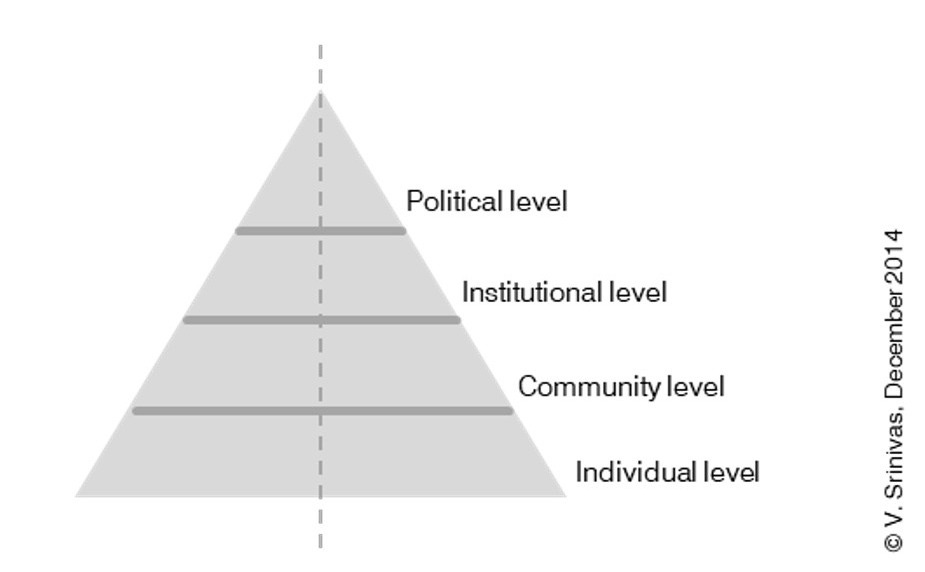
At the political level, change will mean a political class that goes beyond immediate pressures, and is committed to longer-term public interest.
At the institutional level, change will mean rebuilding institutional purpose as the driving force for change.
At the individual level, change means rebuilding the sense of citizenship and responsibility – beyond self.
At the community level, change means acceptance of new ways of thinking and doing rather than a blind rejection of the new in favor of an older way of doing things.
All four types of change have to take place simultaneously – across a nation of 1.4 billion individuals, across thousands of communities, across several hundred institutions, and across a political system that has been systematically corroded over decades – for real change to take place.
Pathway 2: Individual-centered Change
Driving system-led change requires us to take on a gigantic task of fighting inertial forces in every part of our country.
Furthermore, it requires comprehensive efforts at all levels – political, institutional, community, and individual.
There is an alternative path also open to us – one which involves creating the critical mass of changemakers – who by their presence, numbers, and actions – strengthen evolutionary behavior in all parts of the country.
These changemakers, we call contributors. Contributors are individuals who first and foremost focus on expanding themselves – from narrow selfishness to enlightened self-interest which includes not just self, but also institutions and society.
Contributors are those who find solutions and create new possibilities instead of complaining and feeling like victims. Contributors build trust and integrity consistently across all actions. This creates mutual faith and trust in the country.
Contributors are, in short, nation builders, not those who seek to harvest the efforts of others and remain mute spectators, when gigantic challenges need to be overcome.
We need more contributors and a contributor work ethic in governance, business, civil society, and in the day-to-day lives of millions of Indians.
Can we, therefore, intentionally create such a contributor ethic in our society by developing contributors systematically in our schools, colleges, industry, government, and other sectors of society?
Through the development of such a contributor ethic – a cultural, social, and mindset change will sweep across the nation. This will result in an “inside-out change” in the country, where evolution rather than revolution becomes the basis of change.
Integrating both types of change: Human Systems Change
In practice, perhaps, the best solution would probably be a system-driven change driven by committed leaders in institutions and government, combined with a deeper socio-cultural and mindset change brought about by a contribution ethic in all sections of society.
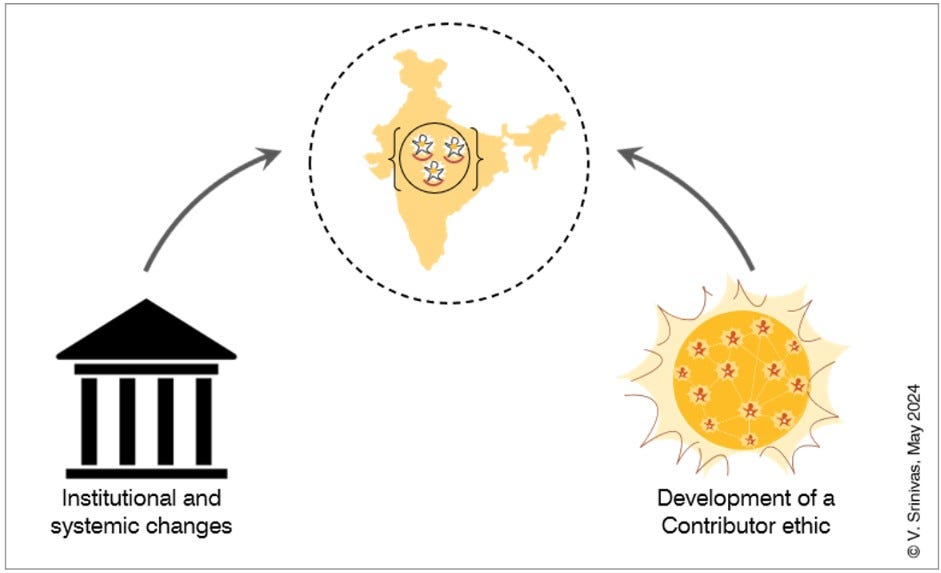
This new model of change we call Human Systems Change.
Human Systems Change recognizes the importance of both perspectives – institutional and human. It also recognizes that the purpose of system is to benefit human beings and make human lives better.
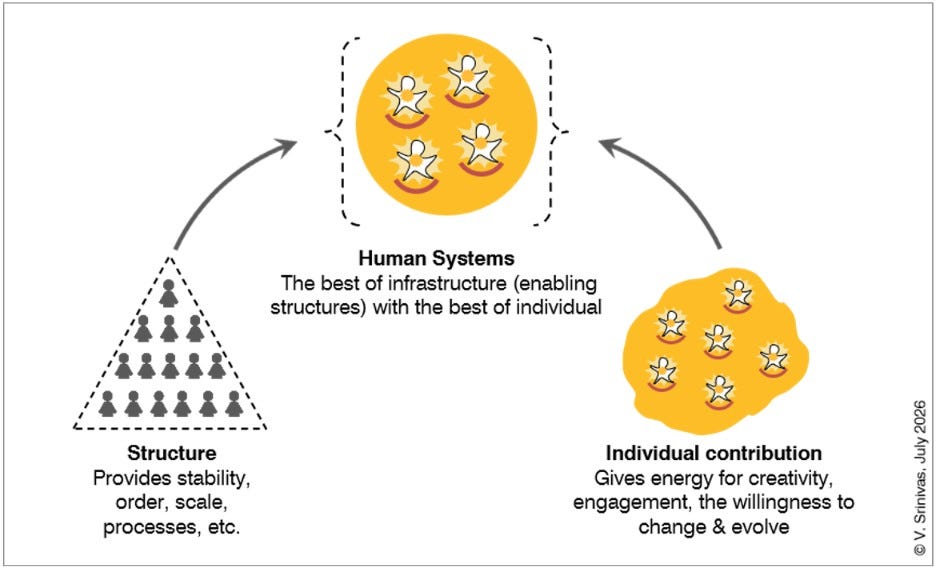
Illumine has applied the human systems perspective in several large organizational systems across government, corporates, education, and communities: including the Capacity Building Commission, MITRA, Indian Railways, SBI, and India Post, large corporations in software, steel, financial services, FMCG, and 400 engineering colleges and 5,000+ schools.
We have learnt that this approach is particularly valuable when
organizations (1) seek to be purpose-centric in their approach, (2) seek to adapt and innovate in a changing world, and (3) seek to create ‘space’ for individuals to contribute while finding ways for the entire ‘value chain’ or system to deliver to its scale goals.
Through this approach, thousands of institutions can be remobilized, or better still, reoriented to their core purposes of serving society and stakeholders.
In this approach, contributors matter, and so do systems, but what matters more is the focus on human welfare and development of our nation.
 | A guest post by
|