

Issue 05: Designing for deep behavioral change
– a checklist for Leaders


Deep behavioral change needs a transformative learning paradigm
Most training programs focus only on knowledge, skills and techniques. They rarely change how people think, how they engage in complex situations, or how citizens experience the system. That is why training alone rarely produces real transformation.
A deep behavioral change program needs a transformative learning paradigm. While a superficial behavioral change program may be done through a skilling paradigm.
What is a transformative learning paradigm?
A transformative learning paradigm seeks to change our thinking, mindsets and behaviour. On the other hand, a skilling paradigm focusses on acquiring specific capabilities to accomplish specific tasks.
Transformative learning includes within its scope the acquisition of specific skills and capabilities. But, when we seek to build intrinsic motivation to serve, or an expanded vision of one’s role, or when one is trying to change the way one interacts with citizens, a skilling paradigm is not enough. Such deep behavioral changes need a transformative learning paradigm.
What kind of outcomes are met in a transformative learning paradigm?
Four kinds of outcomes that you should check for:
1. Learning outcomes. The focus should be on ‘understanding’.
There are several types of learning outcomes. Examples include acquiring knowledge, understanding concepts, learning specific skills, etc. Most traditional training programs stop at learning outcomes.
2. Cognitive outcomes. The focus should be on ‘change in thinking’.
This is applicable to outcomes like changing my thinking, my beliefs, my mental models of the world around me, or the mental tools that I use for engaging with the world.
While ‘tools for thinking’ may be learnt through a skilling paradigm, the deeper mental model shifts need transformative learning.
3. Dynamic response outcomes. The focus should be on ‘how I respond and engage with life/ stakeholders on a real-time basis’.
To engage dynamically, I need to change my modes of engagement, for example, becoming proactive, and moving from being a victim of circumstance to a creator of my destiny.
It is only through a dynamic response capability that I will be able to effectively handle citizen flashpoints, respond to difficult situations, and interact positively with citizens in real-time.
While certain types of scenario-based dynamic response capabilities can be built through skilling, changing one’s modes of engagement requires transformative learning.
4. Citizen/ customer trust outcomes. The focus should be on ‘sustaining positive contributions to the lives of citizens/ customers’.
Closure reflection:
The transformative learning paradigm helps in crossing the bridge from knowing to doing.
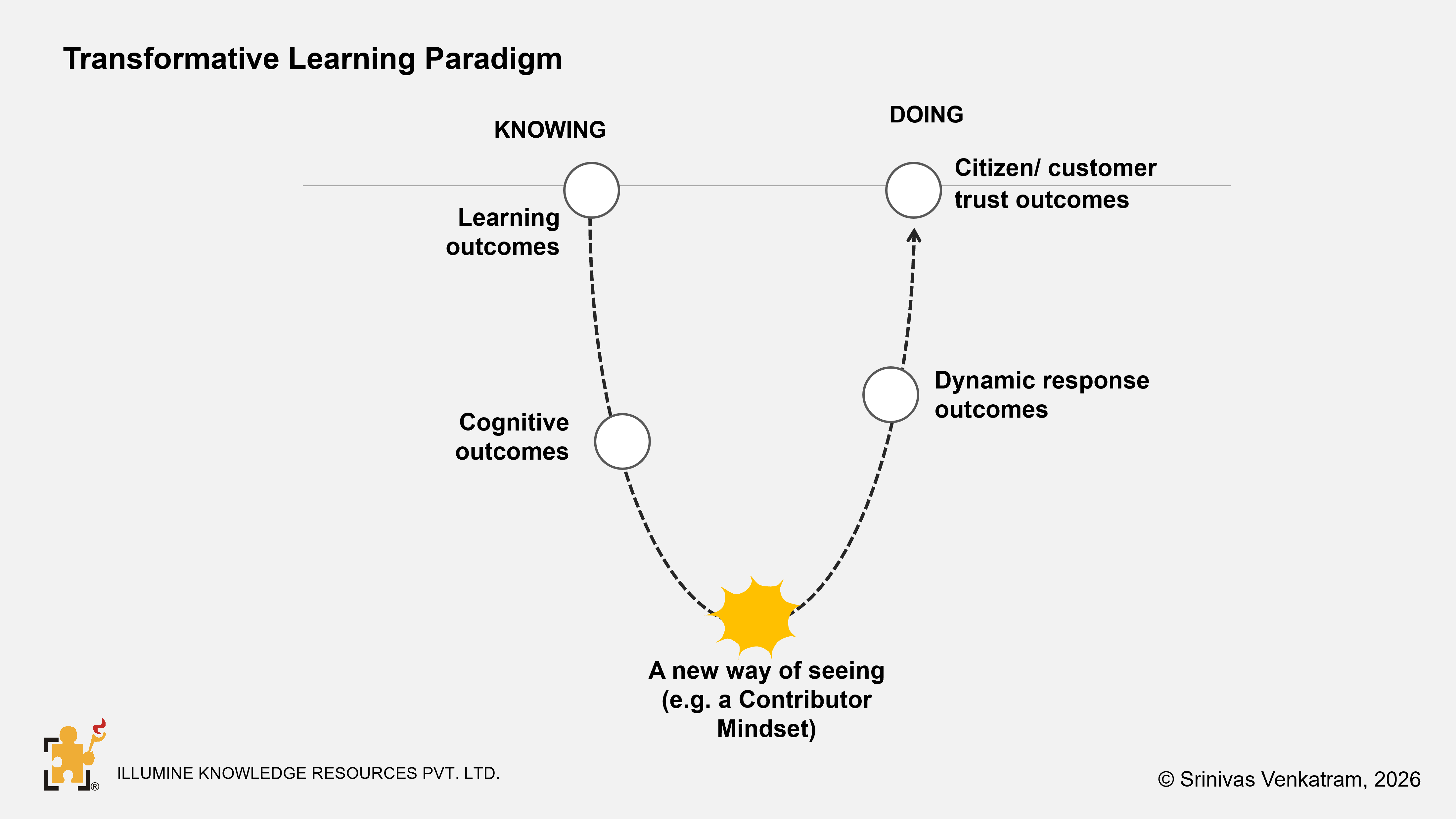
Thus, a good training program for deep behaviour change must help learners cross the bridge from knowledge to action. Otherwise, it is not sustainable in the long run.
Illumine’s experience in deep behavioral change
Over the last 2 decades, Illumine has carried out deep behavioral change interventions in over 5 million people.
These interventions span diverse contexts ranging from oil & gas, banking and financial services, FMCG retailing, capital projects, manufacturing, citizen services like policing, postal, railways, school & higher education, and community transformation.
 | A guest post by
|
Really enjoyed this. Sustainable change is rarely about motivation alone—designing for behavior is where the real challenge begins.