

Issue 06: Creating a Culture of Strength in society
How to help a society retain its sense of priorities in the midst of rapid change

What is a “Culture of Strength”?
This question can be best answered when we attempt to perceive three key trends in our society:
The trend towards increased consumerism
The trend towards increased aspiration
The trend towards increased achievement
Achievement, aspiration, and consumerism appear to be the same force or idea within our society – especially at the level of manifestation.
Great achievement, great aspiration, and great consumerism, all reflect in an atmosphere of pomp & glory within the society – all three are celebrated as “success”.
However, there are fundamental differences between all three:
Aspiration reflects human desire to become more than what one is. This is an “inside-out” phenomenon in a human being.
Achievement reflects human capacity to accomplish – getting things done. This reflects an individual’s capacity to shape the world around him or her.
Consumerism reflects human desire for “results” – for experiencing pleasure – whether or not accompanied by aspiration or achievement.
When a society reflects the trend towards all three, aspiration (transformed states of being), achievement (increased capacity to influence and accomplish), and consumerism (increased desire to taste pleasure), then it gets into a dynamic – that is self-generative.
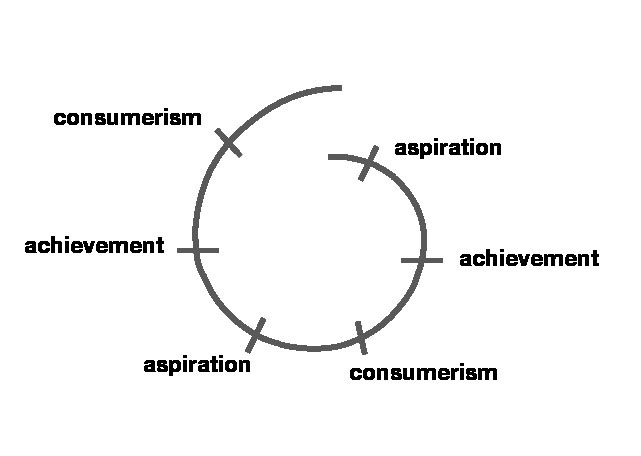
However, such a society faces a threat – the threat of “weakness” – born of a subtle shift in priorities.
As long as aspiration drives achievement drives consumerism, the society grows joyously.
When achievement drives consumerism drives aspiration, the society becomes stressed and competitive.
When consumerism drives achievement drives aspiration, the society becomes deeply selfish and grasping.
The threat derives from the fact that (a) it is hard to recognize what is driving behavior in society at a point in time (b) it is harder still to recognize a subtle shift in priorities – when a society is growing rapidly.
Perhaps this may be a simple explanation for decadence in societies like the Roman Empire, wherein, across generations, the shift took place subtly and not so subtly – the result being a decline from great aspiration to empty consumption.
It is here that the “Culture of Strength” in a society becomes relevant.
The Culture of Strength reflects a society’s capacity to retain its sense of priorities – celebrating aspiration and new levels of being over achievement, and acknowledging achievement more than consumerism in its public discourse.
This capacity is born of a deeper value called renunciation.
Renunciation does not mean “giving up”, but it means constantly “clearing the space”.
When a society constantly “clears the space” for fresh perspectives, fresh ideas, new debate, new challenges, then that society may be said to be “renouncing” its notions of success and failure and preparing itself for new growth.
“Clearing the space” is a non-trivial function in society. It means a vibrant intellectual life, it means openness to alternative models of thinking and doing, it means the willingness to test and experiment with new models of transformation both personally and interpersonally, and most important, it means the capacity to discriminate and judge among alternatives.
“Clearing the space” is possible in a society only when there is a method to integrate creative ferment with institutional stability.
It is this same “creating the space” phenomenon that can cause organizations to become moribund, or retain a fresh flow of innovation with itself.
The society’s capacity to architect and sustain this function of “clearing the space” may be said to reflect its true strength.
A society is strong when it can discriminate between (i) good ideas and bad, (ii) valuable models and those that are destructive, (iii) positive ideals and those that corrode, (iv) enabling values and values that weaken.
A Culture of Strength would be one where these four dimensions are constantly freed of preconceived notions, and society is able to select and act upon, across alternatives on all four dimensions effectively.
Such a Culture of Strength would ensure that the society would continue to live in a positive dynamic of aspiration → achievement → fruits.
 | A guest post by
|